
Grahams of the Border
Who were they?
Approximately one-third of Grahams today descend from the Border Grahams who helped police the Anglo-Scottish Border.
When David I was crowned King of Scotland in 1124, he granted a large portion of land in Annandale near the Anglo-Scottish border to the first Robert de Brus (ancestor of King Robert the Bruce). The purpose was to act as a security zone, a buffer to protect Scotland from incursions. Bruce’s Knights of Annandale, which included Kirkpatricks, Corries, Crosbys, Dunwoodies, and Flemings, were granted portions of Annandale in order to help control the area. A branch of the Grahams inherited some of this land.
In 1300, when the English attacked Caerlaverock Castle, Sir Henry de Graham was one of the nobles who led a cavalry unit into battle during the siege. Grahams continued to help protect Scotland’s border during the Wars of Scottish Independence.
Over a century later, several border clans had taken to cattle and sheep rustling to support their families since any crops planted were destroyed during war. These clans became known as Border Reivers. When James VI of Scotland became James I of England at the Union of the Crowns in 1603, he saw the need to dismantle the border security zone called “The Marches.” The Grahams were singled out as the lead troublemakers and ordered banished to Ireland in 1606. While many returned to Scotland soon after, a few distinguished themselves in military service in Ireland. The sons of Fergus Graham of Mote, Sir Richard and Sir George Graham, distinguished themselves during the Nine Years’ War (1594-1603).
Grahams, Armstrongs, Elliotts and other Border Clans distinguished themselves during the Williamite Wars in Ireland (1689-91), some as members of the Inniskilleners, an elite combat unit, that was appointed personal guard to William I during the Battle of the Boyne.
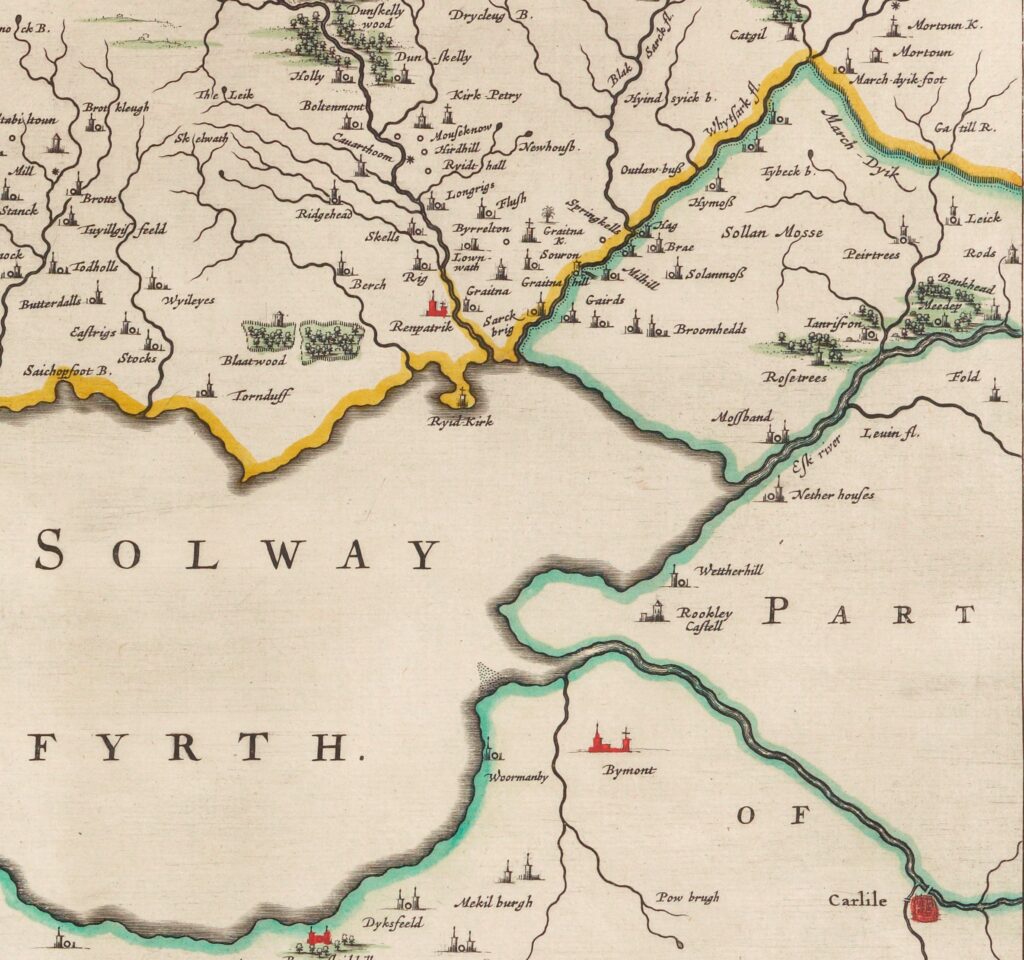
Reproduced with the permission of the National Library of Scotland. Reuse: CC-BY(NLS).
