

A Short Exposition on Tartans Associated with the Grahams
by Dr. Scott F. Graham Long, Ph.D., FSA Scot
Most, perhaps all, readers will have worked a tent or at least visited tents at Scottish festivals throughout the country. Therefore, they will readily profess that many of the questions from patrons of the games concern the tartans associated with their particular family. There is ingrained in Scottish-American culture the notion that the “clan tartan” represents an association with that particular fabric and a specific family that reaches beyond the years of recorded history. However, nothing could be further from the truth, representing the “great tartan myth” as named by Thompson.1 The “clan tartan” as a representation of particular family or clan is roughly 200 years old, dating from the great romanticization of Scottish and Highland culture emanating from the visit of William IV to Edinburgh in 1822 and the planning of said visit by Sir Walter Scott. As the King and the public expected to see the Scots in their family tartans, the establishment of a specific pattern for each clan became a boon to the weaving industry, which was more than happy to deliver clan tartans. Especially important at this juncture was the house of Wilsons of Bannockburn who published the first “tartan book” with associated names in 1819.2
Prior to this, tartans were common place, but the pattern or “sett” was not typically unique to a specific family (although a few references indicate three or four setts associated with particular families dating to the early 18th century). This is amply illustrated by reports of and following the Battle of Culloden (1746). A contemporary painting c. 1750 by David Morier called An Incident in the Rebellion of 1745, portrays the highlanders dressed in any number or tartans, often with different setts worn by the same individual. This suggests there was no “family tartan” but they wore what was available from the weaver. Moreover, in descriptions of the battle and the aftermath, persons were identified as Highlander or Hanoverian not by their tartan but by the color of the cockade in their bonnet (white for the Jacobites and black for the government forces) and by the plant badge in their bonnet (i.e. the laurel for Graham).3,4
It is important to remind and note here that following the defeat of the Jacobites, there was enacted in 1746 (effective 1747) the proscription of the wearing of tartan, the playing of pipes, and the speaking of Gaelic in the Highlands. This act was repealed as a result of a bill introduced into Parliament in 1782 by James Graham, Marquis of Montrose (later the 3rd Duke of Montrose) who was a member of Parliament for Richmond. Thus Scots could freely wear the tartan again.5
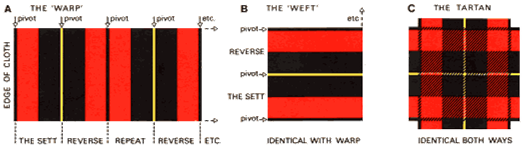
Tartan, is woven using specific sequences of colors and widths of colors in horizontal (warp) and vertical (weft) sequence (Figure 1. Tartan Designer). The thread counts for each determine the width of each section. This establishes the pattern or “sett” of the tartan. As will be noted, the sett of each tartan is its defining characteristic, as the shades of the colors or even the colors themselves may change. 6, 7
The earliest known “tartan” dates back to c. 3 AD. The “Falkirk” tartan was discovered in 1933 protecting a cache of Roman coins near Falkirk. This fragment is more properly described as a checked tweed. However, it does represent known weaving techniques that produce a simple checked or “tartan” design.8 The oldest example of a multi-colored tartan more akin to what is today considered tartan is the Glen Affric, discovered in a peat bog in Glen Affric in the 1980s. It is dated to the 16th century.9
These fabrics were produced locally, using the material available within the area to create dyes to color the material. Thus, Highlanders of the day would have worn whatever was produced at the pleasure of the local weavers, determined by the available materials and their imagination and design. This was standard until the early part of the 19th century and the Scottish storm that captured the imagination of Great Britain as noted above.
Graham Tartans
There are nine tartans that are specifically associated with Clan Graham. Three additional tartans will also be discussed, since they are of interest to the topic as well. It should be noted that despite there being many tartans associated with Clan Graham, there is only one “official” tartan, the Graham of Montrose (noted below as “Graham of Montrose #2”). 10
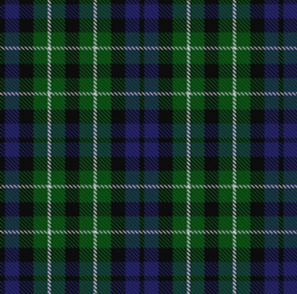
“Graham of Montrose #2” (Figure 2. The Scottish Register of Tartans, (SRT)) Crown copyright. There is a sample of this sett in the 1815 Cockburn Collection, labelled as “Graham.” Wilsons of Bannockburn wove the sett in 1819 but labelled it as “Abercrombie” or No. 64. It was first published in Authenticated Tartans of the Clans and Families of Scotland (1850) and labelled as Graham. The 1859 edition of that book indicates that Meyer and Mortimer of Edinburgh had been supplying the tartan to the Grahams for 30 years. It is also the tartan that is worn by the 205 (Scottish) Field Hospital Royal Army Medical Corps Volunteers and the Chief Makhanda Regiment (formerly First City) of the South African Army. 11, 12, 13
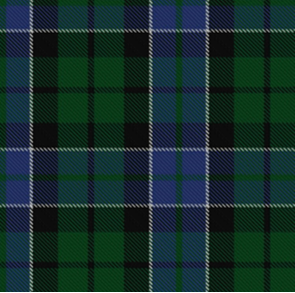
“Graham of Montrose” (Figure 3. SRT) – The Highland Society of London has a 4-inch square sample of this sett. Note the different position of the white stripes, thinner black stripe, and the absence of black stripes within the blue, indicating a different sett.14 This sett is available from some weavers and retailers.
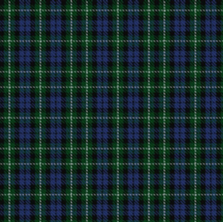
“Graham of Montrose #3” (Figure 4. SRT) – Recorded in 1906 in W. and A.K. Johnston’s The Tartans of the Clans and Septs of Scotland, this is thought to be an error of transcription, omitting a section of the repeating pattern, resulting in a spurious single white stripe between the two double stripes.15
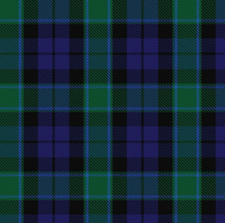
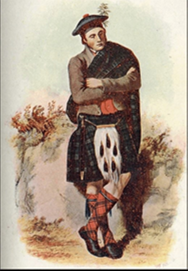
“Graham of Menteith” (Figure 5. SRT) – This sett, often used by members of Clan Graham, was first documented in 1819, labelled as “Cobourg.” It is recorded as a Graham tartan in The Scottish Gael (1831) and by Smibert in 1850.16 It appears to be the sett used by McIan in his illustration of the Scottish Clans (Figure 6).17
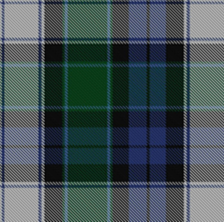
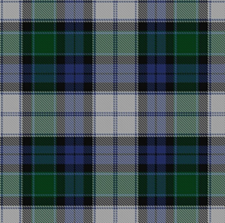
“Graham Dress” (Figures 7a and 7b. SRT) – This pattern dates from an incomplete sample from the 1830 Paton Collection. Dress tartans became popular for formal occasions and often substituted white for one of the other primary colors of an existing pattern.18 In this case, white replaces every other green section. It appears to be based on the Graham of Menteith Tartan, given the azure/smalt lines. However, it is a different sett, as seen by the thin double lines running through the white section and the thin lines flanking the green and blue sections.
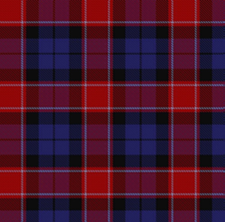
“Graham of Menteith, Red” (Figure 8. SRT) – This is a modern tartan, made in 1980 by Kinloch Anderson for an American customer. It was labelled “Red Montrose” in 1983 by the Scottish Tartans Society. It is the sett for Graham of Menteith with red replacing the green sections.19
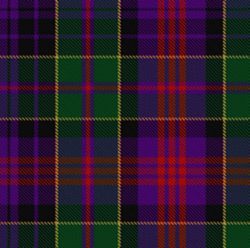
“Graham of Airth” (Figure 9. SRT) – This is a modern “named” tartan produced by D.C. Dalgliesh of Selkirk.20 The title of Earl of Airth was created for William Graham, 7th Earl of Menteith in 1633, a result of claims made that are beyond the scope of the current paper. The earldom became dormant on the death of his grandson, the second Earl.21
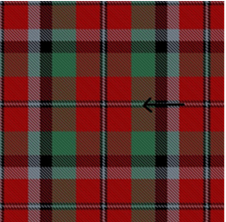
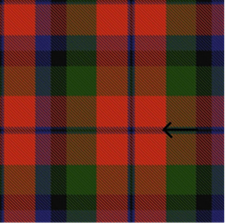
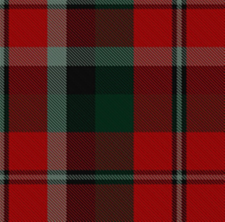
“Graham Red” (Figures 10, 11, 12. SRT) – The Graham Red tartan is based upon the MacNaughton tartan. The only difference in the two setts is that two colors are “swapped” with black flanking blue in the Red Graham and blue flanking black in the MacNaughton, as indicated by the arrows. Muddling the issue, there are two MacNaughton tartans recorded with the Register of Tartans. The one labelled MacNaughton 1831 is considered the correct and official MacNaughton sett has black flanking blue (Red Graham) but is noted that this is considered a weaver’s error from the 19th century. Further complicating the issue, there is also a SRT recorded Montrose (MacNaughton) sett that is basically the Red Graham as well (not presented here).22
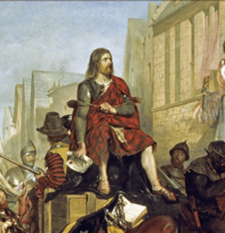
James Drummond (1859)
History (or legend) records that as “The Great Marquis” James Graham, 1st Marquis of Montrose was being led to his death in 1650 he was given a plaid by a MacNaughton as he passed through Fife on the way to Edinburgh, to spare him the indignity of being paraded as a pauper. This is evident in the painting by James Drummond (1859) Montrose (Figure 13, detail, National Gallery of Scotland)23 showing him in a red plaid, with a MacNaughton walking along side through the Royal Mile of Edinburgh on his way to the gallows. It appears that a Graham is being consoled by the MacNaughton in the painting, based on the tartan. This tartan is referred to as the “Graham Red,” the “Red Graham of Montrose,” or the “Montrose (Graham).” It also serves as the District Tartan for Montrose.
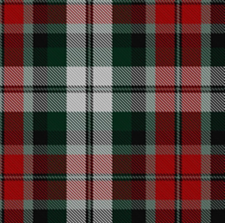
“Graham, Red Dress” or the “Red Dress Graham” (Figure 14, SRT) – This is another modern tartan, designed for an American client for use in Highland Dancing.24 It is the Red Graham described above with one section replaced with white, as is common for dress tartans.
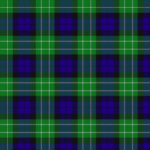
Three additional tartans that have a connection to the Grahams are two district tartans and one tartan of curious historical interest. The Montrose District tartan was noted previously in the discussion on the Red Graham Tartan. There is also a “District of Menteith Tartan” (Figure 15. SRT). It is an old tartan, likely dating from the 1800s. It was mostly forgotten until the 1940s when it was noted in communications of a Graeme Menteith. It is curious in design, having white stripes (like Graham of Montrose) rather than blue (Graham of Menteith).25 The pattern or sett is unlike either, however.
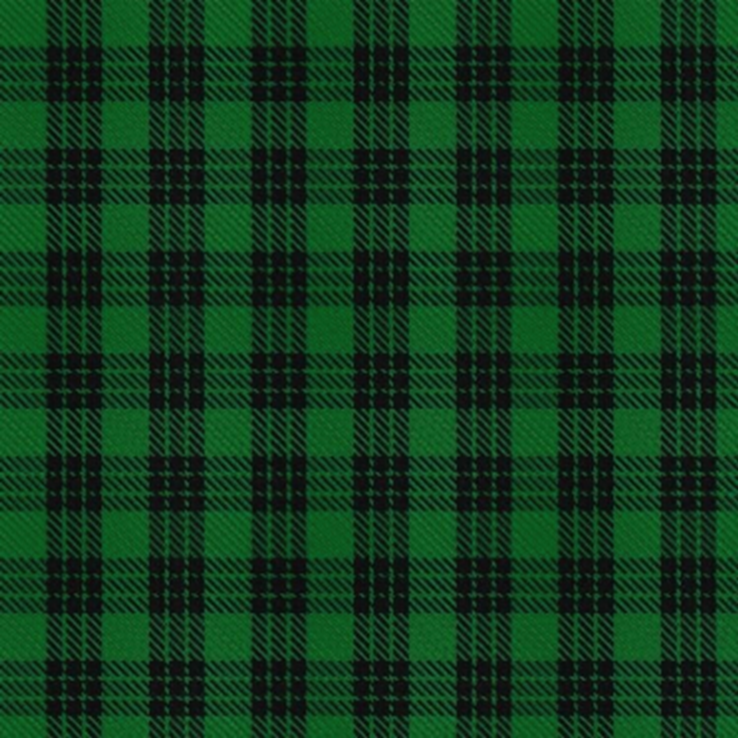
The final tartan is of historical interest. Recorded as the “Graham Tartan” (Figure 16. SRT) in the infamous Vestiarium Scoticum (1842), it is a very simple tartan. John and Charles Allen were English brothers who claimed to be the grandsons of Prince Charles Edward Stuart and they adopted the name Sobieski Stuart (from Bonnie Prince Charlie’s mother Maria Sobieski). They published The Vestiarium Scoticum which is considered by all to be as bogus as their claims to the British throne, but it is a curious document and some of the setts have survived to modern times as Clan tartans.26 Interestingly, this sett is available through some retailers as a Graham tartan.
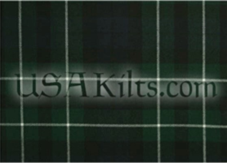
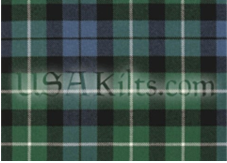
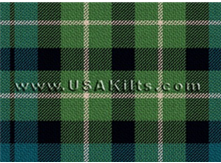
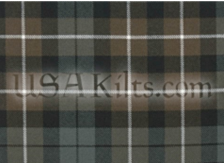
Lastly, many options are available for purchase. Tartans may be labelled as “modern,” “ancient,” “reproduction,” “muted” or “weathered.” Modern tartans are typically manufactured using dark dyes. Ancient, reproduction, and muted tartans are designed to represent the “natural” dyes historically used and are typically lighter in color, “popping” more visually. Weathered is designed to represent the colors of a tartan that have faded over years of use and exposure to the elements. Note that these are *not* different tartans or different setts, but are simply variations in the color palette of the tartan, as illustrated above, using the Graham of Montrose (Figures 17, 18, 19, and 20. USA Kilts, https://www.usakilts.com/ —Thanks to them for their permission to use these images.) 27
Note that personal or commercial tartans using the name Graham were not covered in this paper. Published in the CGS Newsletter dated June 30, 2024.
Sources:
1. J. Charles Thompson, So You’re Going to Wear the Kilt. 3rd Revised Ed. (Arlington, VA: Heraldic Art, 1989).
2. James Grant, Scottish Tartans in Full Color. (NY: Dover Publications, 1992), iv.
3. David Morier (1705?–1770), An Incident in the Rebellion of 1745. Original held by the Royal Collection Trust, King’s Gallery, Palace of Holyroodhouse.
4. Wikimedia Commons contributors, “File:The Battle of Culloden.jpg,” Wikimedia Commons, Accessed June 22, 2024.
5. Jeffrey Banks and Doria de La Chapelle, Tartan: Romancing the Plaid. (New York: Rizzoli, 2007).
6. St. Kilda (Holdings) LTD, “Tartan History and Production,” Tartan Designer, Accessed 23 June 2024. https://tartandesigner.com/designer/historyandproduction
7. George Way, Clans and Tartans, Glasgow: HarperCollins Publishers, 1995).
8. Geoff B. Bailey, “The Falkirk Tartan,” Falkirk Local History Society, Accessed 23 June 2024. https://falkirklocalhistory.club/wp-content/uploads/2019/02/object-4-falkirk-tartan.pdf
9. Carolyn Hagler, “This 16th-Century Cloth Is Scotland’s Oldest-Known Tartan.” Smithsonian Magazine, 5 April 2023.
10. “Tartans of the Grahams,” Clan Graham Society, Accessed 23 June 2024.
11. The Scottish Register of Tartans, (SRT), Crown copyright, Accessed 23 June 2024. https://www.tartanregister.gov.uk
12. William and Andrew Smith, Authenticated Tartans of the Clans and Families of Scotland, (Mauchline, Ayrshire, Scotland:1850), 5.
13. Wikipedia Contributors, “Chief Makhanda Regiment,” Wikipedia, Accessed 23 June 2024. https://en.wikipedia.org/wiki/Chief_Makhanda_Regiment
14. The Scottish Register of Tartans, (SRT), The Scottish Register of Tartans, Accessed 23 June 2024.
15. Ibid.16. The Scottish Register of Tartans, Tartan Details, Graham of Menteith,” Accessed 23 June 2024. https://www.tartanregister.gov.uk/tartanDetails?ref=1482
17. R. R. McIan, The Costumes of the Clans, “Graeme,” (Glasgow: D. Bryce and Son, 1899), 59.
18. The Scottish Register of Tartans, (SRT), The Scottish Register of Tartans, Accessed 23 June 2024.
19. Ibid.
20. Wikipedia Contributors, “Earl of Airth,” Wikipedia, Accessed 23 June 2024. https://en.wikipedia.org/wiki/Earl_of_Airth
21. The Scottish Register of Tartans, Tartan Details, “Graham of Airth,” Accessed 23 June 2024. https://www.tartanregister.gov.uk/tartanDetails?ref=1481
22. The Scottish Register of Tartans, (SRT), The Scottish Register of Tartans, Accessed 23 June 2024.
23. James Drummond, “Montrose,” Oil painting on canvas, 1859, National Galleries of Scotland.
24. The Scottish Register of Tartans, Tartan Details, “Graham, Red Dress,” Accessed 23 June 2024. https://www.tartanregister.gov.uk/tartanDetails?ref=4851
25. The Scottish Register of Tartans, Tartan Details, “Menteith District Tartan,” Accessed 23 June 2024. https://www.tartanregister.gov.uk/tartanDetails?ref=2919
26. The Scottish Register of Tartans, Tartan Details, “Graham,” Accessed 23 June 2024. https://www.tartanregister.gov.uk/tartanDetails?ref=1479
27. USA Kilts, “Graham,” Accessed 23 June 2024. https://www.usakilts.com/gallery/13-16-oz-wool/?keywords=graham


